
If you’ve recently inherited land, bought a rural property, or just stepped away from a few acres for a season or two, Louisiana’s climate has a way of making that painfully obvious. What was once a manageable pasture or timber stand can turn into a wall of brush faster than most people expect. Clearing overgrown land in Louisiana isn’t just about running a brush hog down the middle and calling it done — it’s a process that starts with understanding exactly what you’re dealing with.
This guide is written for landowners across Washington Parish, Tangipahoa Parish, and the North Shore who are ready to reclaim their property — whether that means opening up acreage for grazing, firewood access, a building site, or just getting the land workable again. The process looks different depending on what’s growing out there, and getting ahead of it starts with a realistic site assessment.
Start With an Honest Assessment of Your Land
Before any equipment touches the ground, walk your property — or bring in someone who knows what they’re looking for to walk it with you. What you’re trying to understand is the density and composition of the vegetation.
Light brush — chest-high grasses, small saplings under two inches in diameter, vines like Japanese honeysuckle — is manageable with the right mowing or mulching equipment. But if you’re dealing with an established thicket of sweetgum, water oak, loblolly pine, or mature Chinese tallow trees crowded in among heavy briars and kudzu vines, that’s a different scope entirely.
Look at the terrain too. Louisiana clay soil retains water differently from sandier ground further north. Low-lying areas may be soft or seasonally wet, which limits what equipment can safely access without causing damage or getting bogged down. Drainage patterns, existing slope, and access points all factor into how work gets sequenced. A quick walk with someone experienced in vegetation management will tell you more than any description over the phone.
What Different Vegetation Densities Mean for the Process
Not all overgrown acreage is created equal. Understanding the general categories helps you have a realistic conversation about what’s involved:
**Light brush and vine regrowth:** If your land had been maintained and hasn’t been touched for a year or two, you’re likely dealing with fast-growing vines, briar patches, and young saplings. This kind of growth can often be handled efficiently with forestry mulching or a heavy-duty brush cutter. It’s the most straightforward scenario.
**Mixed brush with established saplings:** Land left alone for several years often develops a layer of competing saplings. Sweetgum is particularly aggressive in this part of Louisiana — it resprouts from stumps and spreads by seed with equal enthusiasm. Chinese tallow, an invasive species that has spread widely across the North Shore and Washington Parish, can form dense stands within just a few growing seasons. This vegetation level typically requires a combination of felling, stump grinding, and mulching.
**Mature timber overgrowth or full pine thickets:** Loblolly and longleaf pine colonize open pasture quickly when land sits neglected. A full pine thicket with a thick understory of privet, sweetgum, and vines is not a brush hog job — it’s a tree removal and forestry mulching project. Work often needs to be sequenced: clear the canopy first, then process the understory and stumps below.
Equipment Considerations: Matching the Tool to the Job
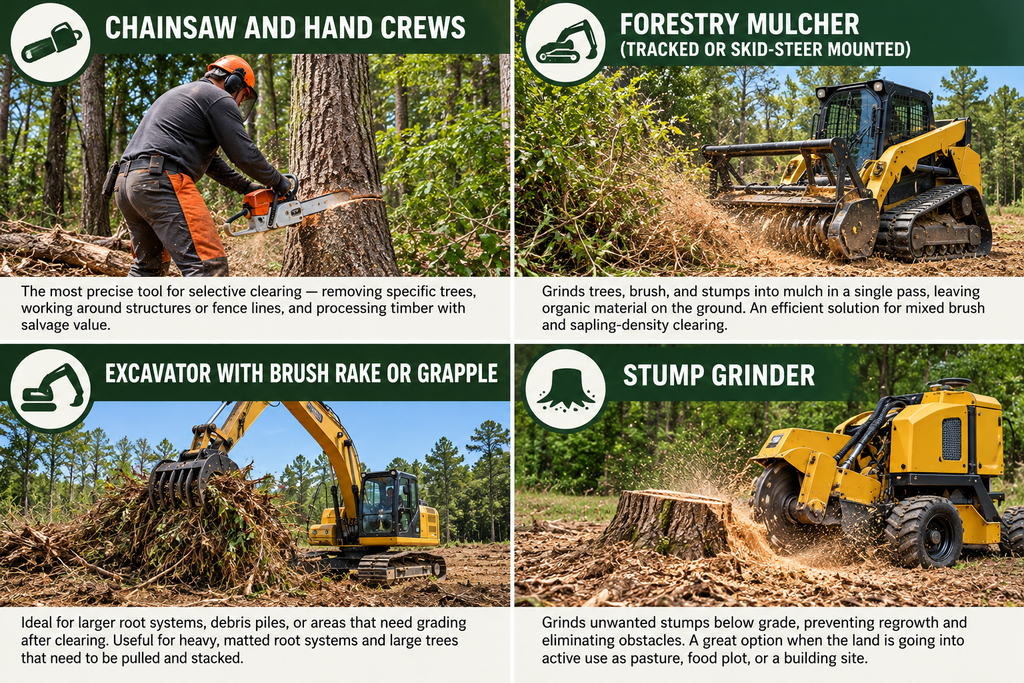
The right equipment for land clearing depends entirely on what’s out there. Here’s a basic overview of the main options:
**Chainsaw and hand crews:** Still the most precise tool available for selective clearing — removing specific trees while leaving others, working around structures or fence lines, or processing timber with salvage value. Chainsaws handle anything with a significant trunk, and experienced hand crews give you the control that machines can’t always match in tight or irregular areas.
**Forestry mulcher (tracked or skid-steer mounted):** One of the most efficient tools available for vegetation management on Louisiana acreage. A forestry mulcher grinds trees, brush, and stumps into mulch in a single pass, leaving organic material on the ground to decompose naturally. It’s particularly well suited for mixed brush and sapling-density clearing because it eliminates the burn pile and haul-off that traditional clearing methods create. The mulched material also helps stabilize soil after clearing.
**Excavator with brush rake or grapple:** When you’re dealing with larger root systems, debris piles, or areas that need grading after clearing, an excavator becomes the right tool. Heavy, matted root systems — especially from large sweetgum or Chinese tallow — sometimes need to be pulled and stacked rather than ground in place.
**Stump grinder:** After tree removal, stumps left in the ground will sprout or become obstacles for equipment and future land use. Stump grinding is a separate step worth considering for land that’s going into active use as pasture, food plot, or a building site.
What Drives the Timeline for Clearing Overgrown Land in Louisiana
This is the question most landowners ask first, and it’s the one that’s hardest to answer without seeing the property. Honestly, site conditions drive everything — and those conditions can’t be evaluated from a phone call.
Vegetation density is the biggest variable. A five-acre field of chest-high brush is a very different project than five acres of ten-year-old mixed hardwood regrowth. Terrain and soil conditions matter too — equipment moves slower on wet, soft clay, and some areas may need to dry out before heavy machinery can access them without causing unnecessary ground disturbance.
Site access is a real factor. Properties with good road access or established internal trails are much easier to work efficiently than landlocked parcels with no clear entry point for a trailer and equipment. How far equipment has to travel on-site to reach the work areas adds up across a larger property.
Landowner goals shape the scope as well. Are you clearing everything, or selectively preserving some trees? Do you want stumps ground down flush, or are you fine leaving them? These decisions affect how the work is staged and what it takes to complete it.
Louisiana’s growing season also means that vegetation management isn’t always a one-time event. Fast-growing species like sweetgum and kudzu can re-establish quickly, and some properties benefit from a phased clearing approach — especially where invasive species have taken a strong hold.
Louisiana-Specific Vegetation Challenges Worth Knowing About
A few species deserve special attention for landowners in Washington Parish and across the North Shore:
**Kudzu:** This vine can cover a tree canopy in a single growing season under the right conditions. The root system is extensive and stores significant energy reserves — mature root crowns can weigh hundreds of pounds. Cutting kudzu aboveground stimulates vigorous regrowth from the roots. Mechanical clearing, including forestry mulching, sets it back significantly, but managing kudzu long-term typically involves monitoring and addressing regrowth in the seasons following initial clearing.
**Chinese tallow (Popcorn tree):** An invasive tree that spreads aggressively in Louisiana’s humid climate. It grows fast, produces prolific seed that birds distribute widely, and can form nearly monocultural stands on neglected land. Cutting stimulates aggressive stump sprouting, which is why removal — not just cutting — is the more effective approach.
**Sweetgum:** Not invasive, but a prolific native hardwood that recolonizes disturbed ground quickly. The gum balls and aggressive root growth make it a nuisance in areas being prepared for other uses. Stump grinding after removal helps reduce resprouting significantly.
Frequently Asked Questions
- Q: How do I know if I need a forestry mulcher or just a brush hog?
- A: A brush hog handles grasses, weeds, and light brush up to about an inch in diameter. If you’ve got saplings, thicker shrubs, vines established around trees, or anything woody in the ground, a forestry mulcher is the more effective tool — it grinds and processes material rather than just mowing over it.
- Q: Can I burn what’s cleared instead of mulching it?
- A: Burning is common in rural Louisiana, but it requires checking current state and local burn regulations, weather conditions, and proximity to neighboring property. Forestry mulching avoids those concerns and returns organic material to the soil. For larger debris piles, a combination of on-site burning and mulching is sometimes the practical approach.
- Q: Does clearing disturb the soil or cause erosion concerns?
- A: It can, depending on method and terrain. Forestry mulching is considered lower-impact because the machine moves across the surface and leaves mulch behind, which actually helps stabilize soil after clearing. Excavation-based clearing removes more material and may require erosion control measures, especially near drainage areas or slopes.
- Q: Will invasive species come back after clearing?
- A: Many will attempt to, especially kudzu and Chinese tallow. Mechanical clearing removes aboveground vegetation and disrupts root systems, but some species resprout aggressively. A realistic vegetation management plan often includes a follow-up visit to address regrowth — particularly in the first growing season after initial clearing.
- Q: Is there a better time of year for land clearing in Louisiana?
- A: Late fall through early spring is generally preferred when the ground is firmer, vegetation is dormant, and temperatures are more manageable for crews and equipment. That said, clearing happens year-round in Louisiana, and the best timing depends on your specific property conditions and timeline.
Ready to Reclaim Your Louisiana Land?
If you’ve got overgrown acreage in Franklinton, Washington Parish, or anywhere across the North Shore — from Hammond and Covington to Slidell and Bogalusa — Jack’s Tree Service has the equipment and experience to assess what you’re dealing with and put together a realistic plan. Clearing overgrown land in Louisiana isn’t a cookie-cutter process, and we don’t treat it like one. We’ll walk your property, give you straight answers about what’s out there, and help you figure out next steps.
Call us at **(985) 515-8939** to schedule a property assessment.